Try it
Brown
Black
Red
Gold
Understand the result
What's going on
A resistor is too small to print a number on, so manufacturers paint the number instead - as a sequence of colored bands. Learn the code once and any resistor in the drawer becomes readable at a glance, no multimeter required.
The formula
R = (D1 × 10 + D2) × Multiplier
D1 and D2 are the first two digits, read left to right starting from the band closest to the edge of the resistor.
Show the derivation, mnemonic, and worked example
Build it up
Four bands, four jobs. The first two bands are digits - they spell out a two-digit number. The third band is a multiplier - it tells you how many zeros to add (or, for gold and silver, how far to shift the decimal point). The fourth band is tolerance - how far the real resistance is allowed to drift from that number.
Worked example
Worked example
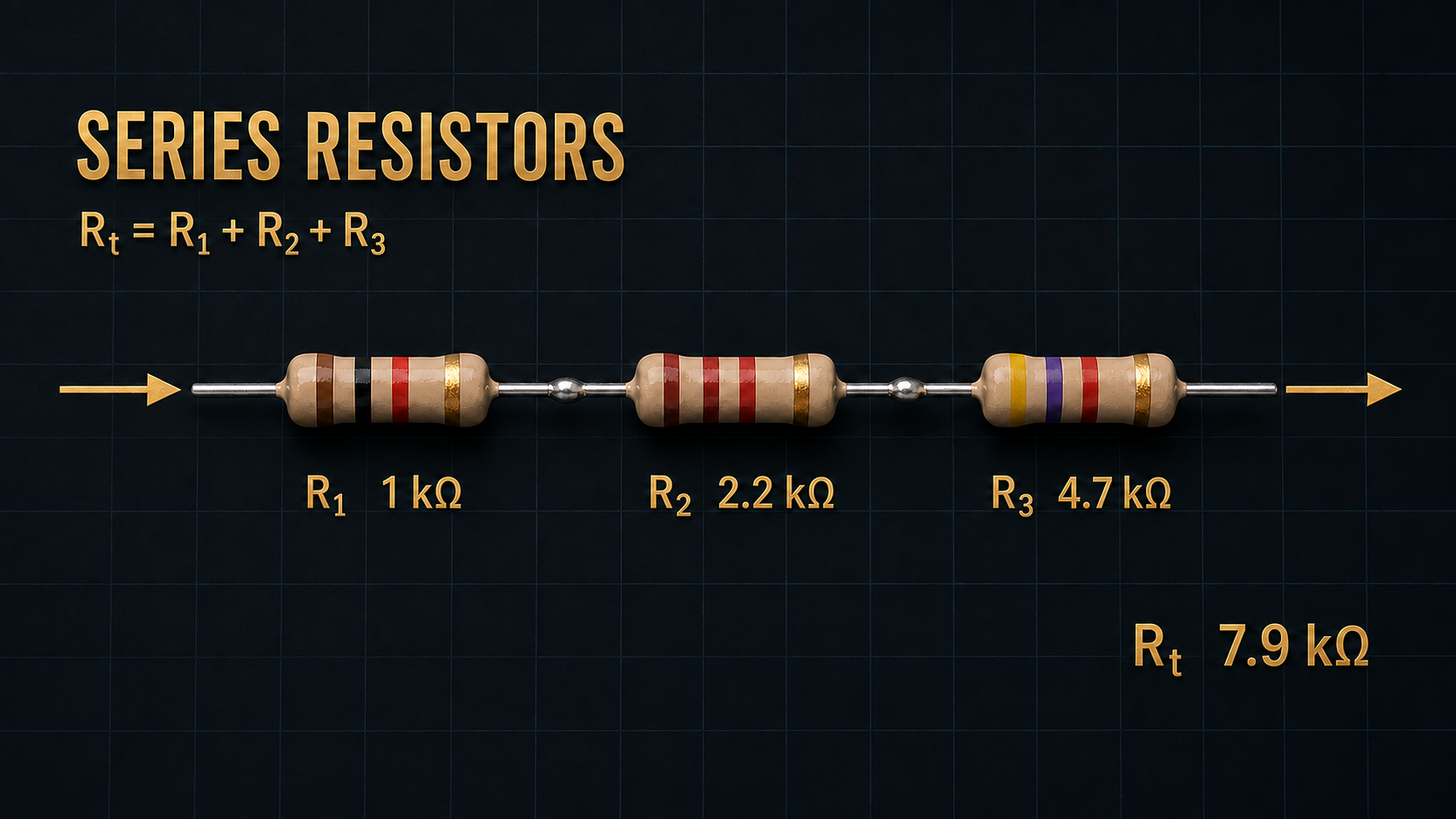
Bands: Brown, Black, Red, Gold
Digits: 1, 0 → 10
Multiplier: Red → ×100
R = 10 × 100 = 1,000 Ω = 1 kΩ ± 5%