Try it
C blocks the lows, R defines Vout - highs pass through relatively unblocked
Understand the result
What's going on
A high pass filter is a gatekeeper for frequency: signals above a certain pitch sail through mostly untouched, while anything below that pitch gets weaker the lower it goes. It’s the circuit behind stripping DC offset or hum out of an audio signal.
The formula
fc = 1 / (2π × R × C)
fc is the cutoff frequency in Hz, R in ohms, C in farads.
Show the derivation, mnemonic, and worked example
Build it up
Build it from a capacitor and a resistor in series, and take the output across the resistor. A capacitor’s resistance to AC (its reactance) drops as frequency rises - so at high frequency the capacitor barely blocks anything, and most of the signal reaches the resistor’s output. At low frequency the capacitor’s reactance climbs and starts eating the signal before it gets there. The cutoff frequency is the point where the resistor and the capacitor are fighting the signal equally.
Worked example
Worked example
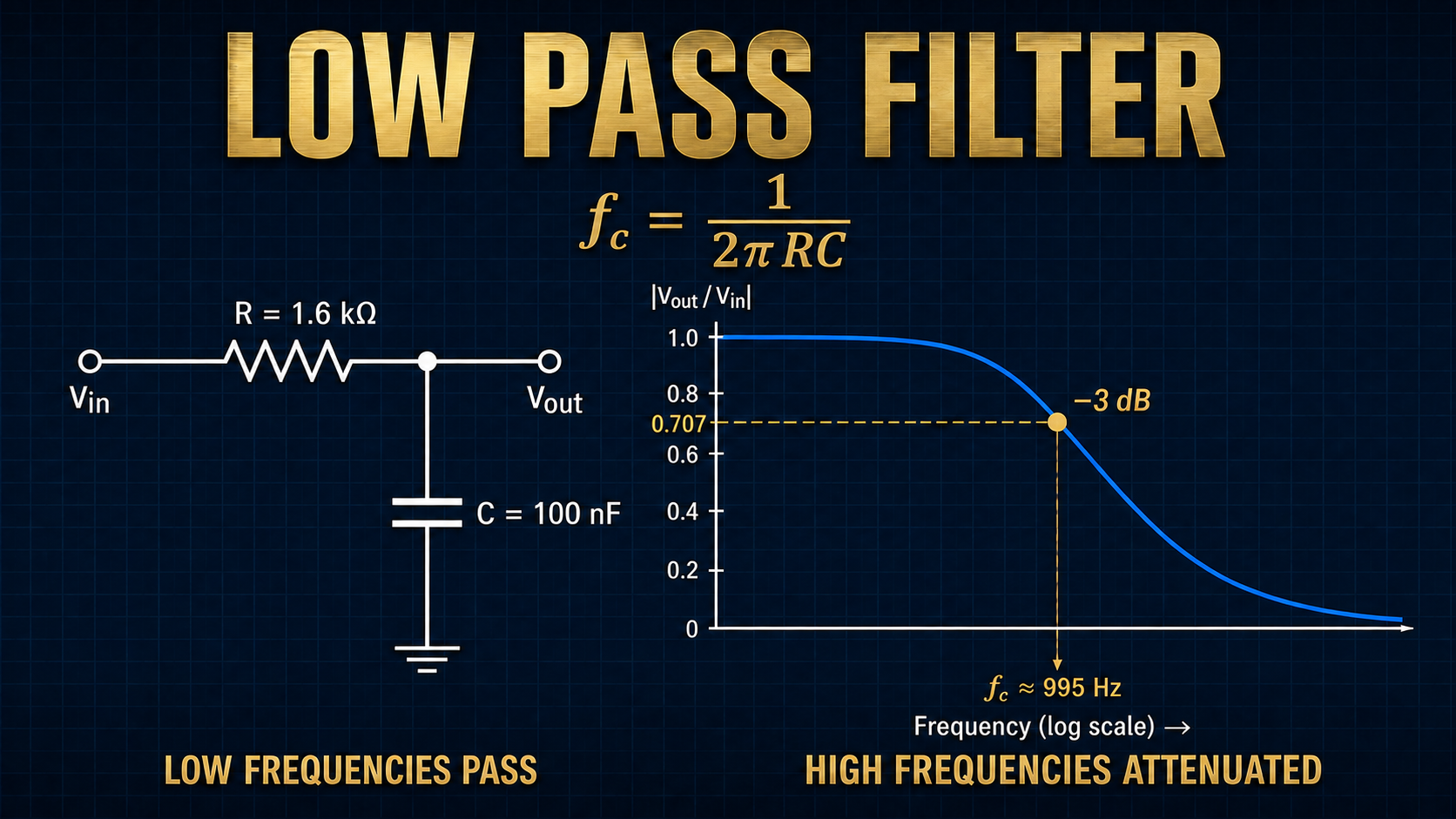
R = 1.6 kΩ, C = 100 nF
fc = 1 / (2π × 1,600 × 1e-7)
fc ≈ 995 Hz